
For those considering a well
Considering a well?
What we'd like you to know before we drill
A well is not something you simply turn on like a tap. It takes effort, and we cannot give guarantees. So that you will still be glad you chose a well, we tell you the good points and the not-so-good points up front.
01
Mains water and well water are not the same "water"
Mains water is river water that has been purified at enormous cost, sent through water mains and pumped electrically to each home. Turn the tap and you always get water of the same quality. That is because people keep working and money keeps being paid to maintain that system.
A well is different. A single pipe draws water up from invisible strata made of soil and sand. There is no treatment plant in between.Whatever is underground comes out as it is.
We use the same word, "water," but please think of them as completely different things. Whether or not you understand this one point makes a big difference in how satisfied you will be after getting a well.
02
What we cannot guarantee before drilling
We'll be honest with you.
We cannot determine in advance at what depth water will come out.We carry out a pre-diagnosis based on published boring data, geological maps from AIST and terrain data from the Geospatial Information Authority of Japan, but this is a "diagnosis of possibility," not a "guarantee." Strata can change within just a few dozen meters.
How much water will come out also cannot be known until we drill.Sometimes there is plenty; sometimes it is less than expected.
The water quality also cannot be known until we drill.It may be high in iron, or manganese or odors may appear. The deeper you drill, the stronger this tendency becomes.
Not knowing how deep we will have to go — taking on that uncertainty is what well work is.
Our estimates are based ona standard depth of up to 50 m. Within this range, the price is the same whether we finish shallow or have to drill to 50 m.
If 50 m does not give enough water and we drill deeper, we will bill the additional drilling and materials separately after the work is complete. The maximum depth our drilling rig can reach is70m. We will always consult you before deciding whether to keep drilling — we never drill deeper without telling you.
Not included in the estimate and charged separately
- Water purification system for drinking — Specifications depend on water quality, so we quote this separately after the water comes out and its quality is checked
- Sand filter — Needed when there is a lot of sand. Quoted separately after checking conditions once water comes out
- Cold-weather / anti-freeze specifications — May be needed depending on the outdoor installation. Discussed on site and charged separately
- Drilling beyond 50 m — As described above
- Piping into the house & electrical work — This may fall within the scope of your house builder or electrician
If no water comes out after all
In the unlikely event that no water comes out,the job ends with only the 50% deposit. We will not charge the balance. If you would like to try drilling at another spot, please let us discuss it with you again.
You might wonder why the price is the same even when the well turned out shallow.
For a 10 m well and a 50 m well, the drilling effort differs somewhat, butthe total amount of work hardly changes.Preparing equipment and materials, transporting and bringing them on site, setting up, assembling and adjusting the rig, leveling and cleaning after the work, packing up, and maintaining the equipment back at the shop — the steps other than drilling make up most of a well job.
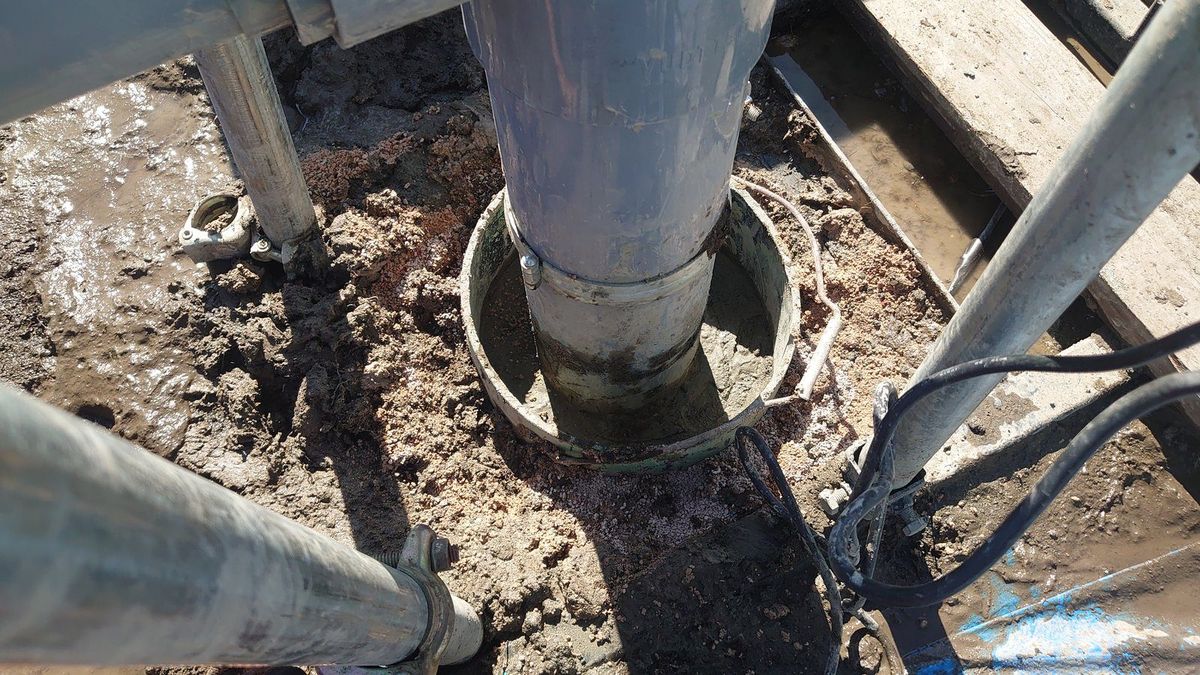
That is whyas long as we stay within the standard depth, there is no extra charge whether the well is shallow or deep.The price stays as originally quoted.
03
The schedule cannot be predicted
We also want to tell you up front that we cannot promise a schedule for well work in advance.
We sometimes hit large stones at shallow depths. Drilling with our rig can take longer than expected. Partway through, the inside of the hole can collapse and sand or soil can fall in. When that happens, we move to another spot and drill again.
Digging underground means working with nature.As long as we are dealing with things we cannot see, these things will happen.
Sometimes it takes a month.
And only after one job is finished do we schedule the next customer who booked. If the previous site runs long, the next one moves too. Please understand in advance that customers are served in order.
Once the pre-drilling geological survey is complete,we will let you know the best drilling depth for your land, an estimated schedule and the cost.We cannot make promises, but we will share our outlook.
Besides wells, we also do handyman work.While drilling a well, we turn down other work as much as possible to keep the schedule open.Even so, urgent jobs sometimes come up. Please understand in advance that on those days we may be away from your site.
Also, we do not work solidly from 9 a.m. to 5 p.m. every day.Start and finish times change depending on that day's plan.Some days we start early; some days we stop and wait. All of that is part of the schedule.
We will explain, consult and report on progress and site conditions as we go.
Drawbacks of a small drilling rig
- Compared with drilling by large machinery,the schedule is less predictable
- Compared with ordinary construction work,it costs relatively more
There is a reason we still take on jobs with a small rig.
With large machinery you can certainly drill faster and deeper. But the cost then becomes out of proportion for a home or office well.
Our rig is small, butwe use the pre-drilling geological survey and our experience to determine where and how deep to drill.That is how we can deliver home and office wells — which would be very expensive with large machinery — at a realistic price.
In Hokkaido there is still land without mains water. Those are exactly the places that need wells. That is why we work with a small rig.
04
What we ask you to prepare on the day of work
Well work only succeeds with the customer's cooperation. During the preliminary site survey, we will check the following together with you.
Water used for drilling
Drilling uses a lot of water. The plan changes depending on whether we can get water nearby. If that is difficult, please let us discuss other arrangements.
Route for the rig and trailer
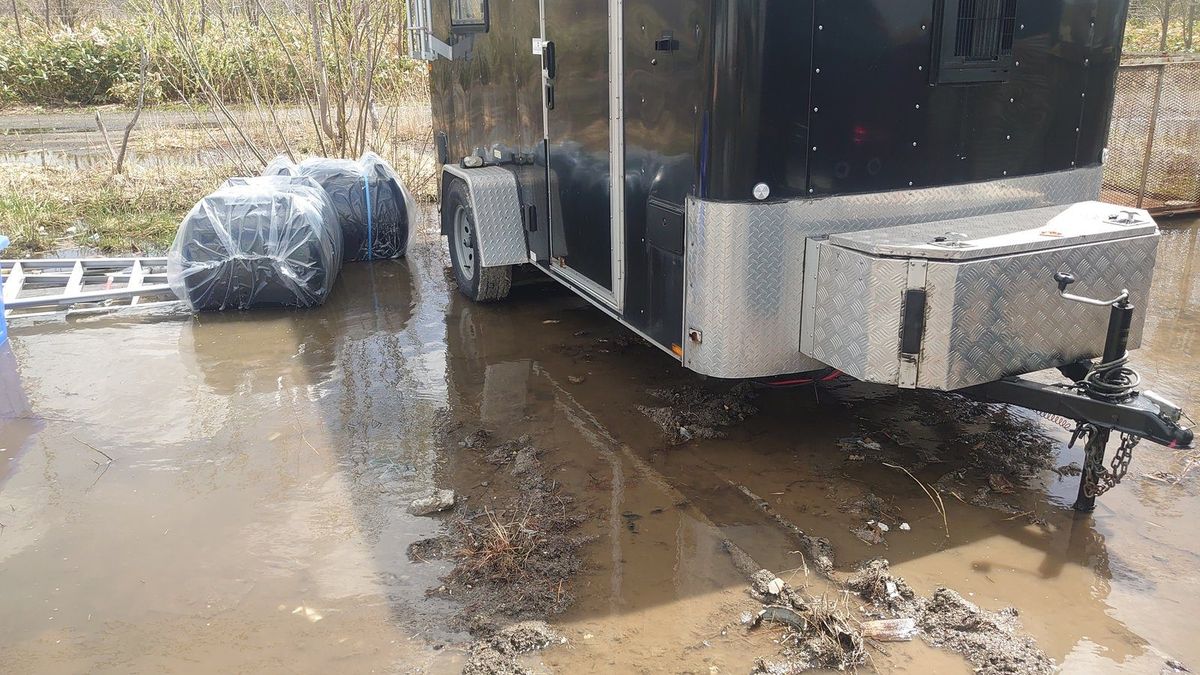
The first hurdle is whether the equipment can get onto the property. We check the access route and the places that need protection together on site.
Space for spoil and muddy water
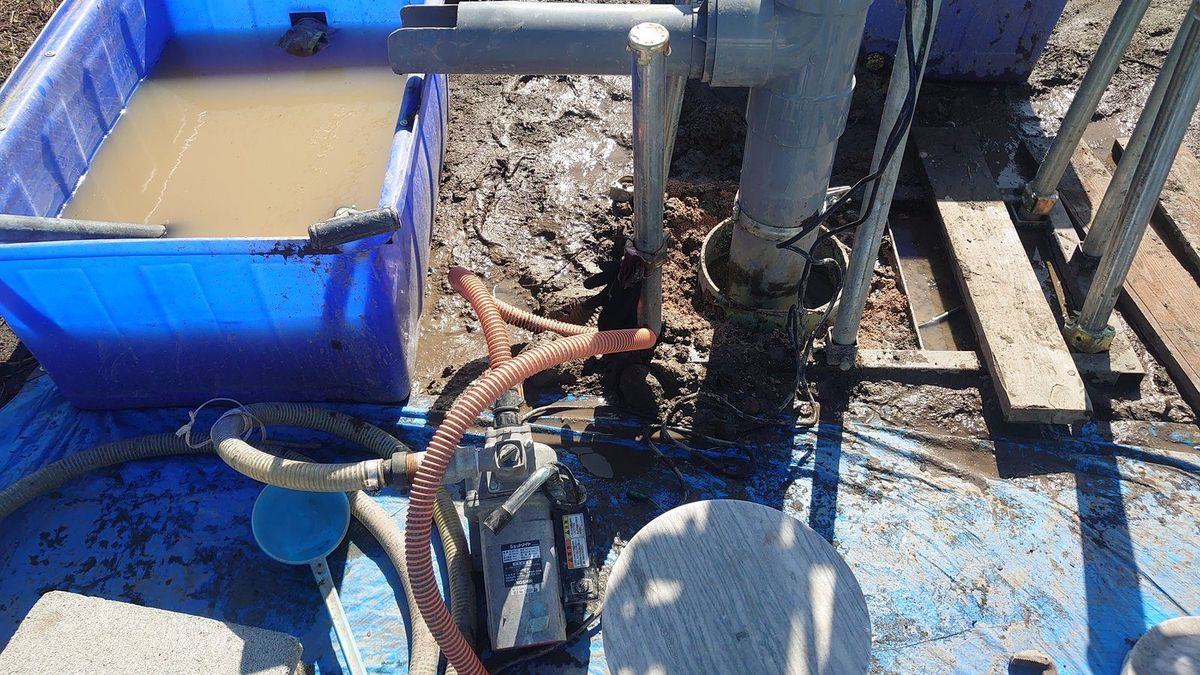
Spoil and muddy water from drilling are handled on site instead of being hauled to a disposal facility, so we do not charge for transport and disposal. This requires space on your property.
05
Six months after the water comes — a well is something you "raise"
The water is not clear and colorless from the moment it comes out.
Hokkaido in particular is land built on thick layers of volcanic ash.Sand and cloudiness will always appear.This is not a failure; it is simply what a well is like.
A well turns into good water as you use it. Pumping water draws out the fine sand around the well and opens up the water's pathways.For a while after the water comes out, you need to "raise" the well by repeatedly running and stopping it.
During this period you use a sand filter and other filters to remove sand and cloudiness. Filters also clog quickly at this stage. It takes effort, but once you get past it, the water settles down.
For those moving into a newly built home
If the well is finished before you move in, you will need temporary power and to run the well regularly. Raising the well first, rather than waiting until the house is built to start it, means the water will be more settled when you move in. Let us discuss how to get power and how often to run it on site.
06
Until it becomes drinking water
Please think of household water and drinking water separately.
Household water for baths and laundry can be used once it passes through a sand filter. It may feel a bit like enjoying hot-spring water.
To use it for drinking, it must also pass through a commercial water purifier, andyou need a water quality test to confirm it is suitable for drinking.Once the water quality has settled, the customer arranges the test.
And now the most important point.After the water comes out, managing the water is the customer's responsibility.Our job covers drilling the well and setting up the equipment. After that, checking water quality, replacing filters and cleaning are the well owner's role.
Of course we will give advice and support. Please feel free to contact us when you have trouble. But we want to say from the start that this is on a completely different level from mains water, where you just turn on the tap.
07
A facility you will live with for life
About well maintenance and upkeep
A well is not finished once it is drilled.
Things that will definitely come up after you own one
- In dry years, the water level may drop.In years with little rain or snow, groundwater decreases.
- When the power goes out, the water stops.A well is pumped by an electric pump. Saying it is "resilient in disasters" only holds if you have a generator.
- The submersible pump is a consumable part.Depending on use, it will eventually need replacing. Please keep that future cost in mind as well.
- The sand filter needs regular cleaning and the filters need regular replacement.That is why it must be installed indoors where a person can stand and work, and where it will not freeze even in winter.
- Once a well is installed, you need to notify your local municipality.Many municipalities also require regular water quality testing.
08
Living with a well — after ten years
From the personal experience of Nojima, owner of Nojima Well Workshop
From here, let me talk about myself as a well driller. Not numbers or technology — just what I have felt.
About ten years ago, I drilled a well at my family home in Saitama. We stopped using mains water and switched the whole house to well water.I connected the well water directly to the bath and the boiler.
What surprised me was the bath. Even in quite hot water, 42 to 45°C,I could soak for an hour without feeling dizzy at all.
Things I had taken for granted stopped happening.
I wondered why. Tap water contains chlorine for disinfection. Well water contains no chemicals at all.Perhaps the body's sweat glands dislike the chlorine coming in and close up, making it harder to sweat.Perhaps that is what feeling light-headed in the bath is — that is how it felt to me.
One more thing changed.My body felt refreshed even without soap.Since then, I have lived for ten years using almost no soap. A life with neither soap ingredients nor chlorine going into my body.
Now I have moved to Hokkaido, and since my home is rented, there is no well. Instead, I put baking soda in the bath. It gave me a similar feeling.
A well is a gift of nature.It is neither colorless nor tasteless.Minerals and many other components are dissolved in the water. Even so — no, precisely because of that — I think the human body craves it. It tastes good.
Of course, for drinking water, to be safe we recommend passing it through a purifier and getting a water quality test. That is where you should be careful.
Disclaimer
What is written in this section is based on the personal experience of our owner, Nojima. It has not been medically verified, and no effect is guaranteed. How people feel about water differs from person to person. Also, a bath heated with well water is not a hot spring as defined by the Hot Springs Act.
09
Still, choosing a well
We have written honestly up to this point. It takes effort. We cannot give guarantees. Maintenance is up to you.
Even so, a well has things only a well can offer.
Once it is drilled, there are no water bills.All you pay for is electricity and replacement filters. No matter how water rates change in the future, it does not affect you. The longer you live there, the more the difference adds up.
And you draw water from beneath your own land.Not water piped in from a river, but water filtered by the strata of that place over tens of thousands of years. The taste differs from land to land. Even water with a slight iron smell isn't bad once you get used to it.
The more care you put in, the more the water rewards you.
Please ask us anything you are unsure about. We believe clearing away your worries before we drill is half of our job.
Just like raising a child, we hope you will love it and enjoy a long relationship with it.